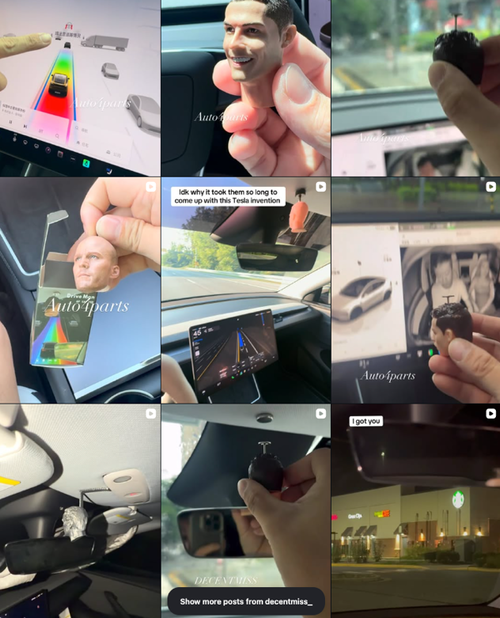
The Catalyst: Viral Deception Exposes FSD Vulnerability
The integrity of Tesla's Full Self-Driving (FSD) system's driver monitoring capabilities has been called into question following the widespread emergence of videos on social media demonstrating a novel method of circumvention. On July 11, 2026, a viral video, shared by an Instagram user identified as "decentmiss_" and subsequently amplified across platforms like Twitter, showcased miniature doll-heads being used to trick the in-cabin camera designed to ensure driver attentiveness. These small, human-like effigies, often marketed as dashboard decorations or "travel companions," are reportedly being sold on Chinese e-commerce platforms for prices ranging from $20 to $50. Their strategic placement near the rearview mirror creates the illusion of a human face, thereby deceiving the FSD system's internal monitoring mechanisms into registering a driver as attentive, even when they may not be. This development has ignited a significant debate regarding the robustness of current driver assistance systems and the persistent ingenuity of users seeking to bypass safety protocols. Fred Lambert, writing for the EV blog Electrek, was among the first to highlight this alarming trend, stating directly that "anyone mounting a fake head to defeat their Tesla's driver monitoring system is putting their life and the lives of everyone around them at risk." Lambert further condemned the sellers, noting they are "profiting from these devices are enabling potentially fatal behavior for $30 a pop." The immediate fallout includes heightened scrutiny from safety advocates and a clear imperative for Tesla to rapidly deploy a countermeasure to address this newly identified vulnerability, which could have severe implications for road safety if left unaddressed.
The rapid dissemination of these videos underscores a critical challenge for autonomous and semi-autonomous vehicle manufacturers: the ongoing cat-and-mouse game between system designers and users attempting to exploit loopholes. The miniature heads represent a sophisticated evolution of defeat devices, moving beyond simpler mechanical tricks to exploit the visual processing capabilities of the cabin camera. This incident is not merely a technical glitch; it highlights a behavioral aspect where some drivers prioritize convenience over safety, actively seeking ways to disengage from the driving task while FSD is active. The fact that these devices are openly sold and marketed for this specific purpose on major e-commerce platforms suggests a growing, albeit dangerous, market for such circumvention tools. The immediate response from the automotive community and safety experts has been one of alarm, emphasizing the potential for increased accidents and fatalities if drivers are allowed to operate vehicles with advanced driver assistance systems without proper supervision. The incident serves as a stark reminder that even the most advanced technological safeguards can be undermined by human intervention, necessitating continuous vigilance and rapid adaptation from manufacturers.
The timing of this discovery is particularly sensitive, given the ongoing public and regulatory discussions surrounding the safety and deployment of FSD and similar advanced driver assistance systems. Tesla's FSD system, especially in its more aggressive modes like "Mad Max" or "Hurry," already requires increased driver supervision, a mandate that these miniature heads directly undermine. The viral nature of the videos ensures that this issue will not remain confined to niche online communities but will likely attract broader media attention and potentially prompt inquiries from transportation safety authorities. The challenge for Tesla now is not only to implement a technical fix but also to manage the public perception of FSD's safety and reliability in the face of such deliberate circumvention. The incident could also influence future regulatory frameworks for autonomous vehicles, potentially leading to stricter requirements for driver monitoring systems across the industry. The immediate priority, however, remains the swift deployment of a software update to neutralize the effectiveness of these deceptive devices and reinforce the critical role of human supervision in semi-autonomous driving.
Historical Context: The Evolution of Driver Monitoring and Defeat Devices
The challenge of ensuring driver attentiveness in vehicles equipped with advanced driver assistance systems (ADAS) is not new, nor is the phenomenon of users attempting to bypass these safety features. Historically, as ADAS capabilities have grown, so too have the efforts to circumvent their monitoring systems. Early iterations of adaptive cruise control and lane-keeping assist systems primarily relied on steering wheel torque sensors to detect driver presence. These systems would issue warnings or disengage if no torque was detected for a certain period, assuming the driver had removed their hands from the wheel. However, resourceful drivers quickly discovered "defeat devices" such as counterweights, often water bottles or specialized gadgets, that could be attached to the steering wheel. These weights would apply a constant, albeit artificial, torque, tricking the sensor into believing a human hand was present. This allowed drivers to operate vehicles hands-free for extended periods, a practice explicitly warned against by manufacturers and safety regulators due to the inherent risks.
Tesla, a pioneer in ADAS with its Autopilot and FSD systems, has been at the forefront of this technological arms race. Recognizing the limitations of steering wheel torque sensors, the company began integrating more sophisticated driver monitoring solutions. The introduction of the in-cabin camera marked a significant evolution in this effort. This camera, typically mounted near the rearview mirror, was designed to directly observe the driver's head and eye movements. Its purpose was to detect signs of inattentiveness, such as prolonged glances away from the road, closed eyes, or head slumping, which are indicative of distraction or drowsiness. By monitoring these visual cues, Tesla aimed to create a more robust and difficult-to-trick system compared to its predecessors. The cabin camera was intended to be a critical safeguard, ensuring that even when FSD was engaged, the human driver remained an active participant, ready to take over at a moment's notice. This shift from indirect (torque) to direct (visual) monitoring was widely seen as a necessary step to enhance safety and mitigate the risks associated with driver complacency.
Despite these advancements, the recent discovery of miniature doll-heads successfully bypassing the cabin camera highlights the continuous nature of this challenge. The current incident mirrors the earlier steering wheel weight circumventions, but with a new technological twist. Instead of mechanical manipulation, the new method exploits the visual recognition algorithms of the camera itself. This suggests that while the cabin camera was an improvement, its current implementation may still rely on relatively simplistic facial detection or presence algorithms rather than more advanced, nuanced behavioral analysis. The history of defeat devices demonstrates a clear pattern: as manufacturers implement new safety measures, a segment of users will inevitably seek ways to bypass them, often driven by a desire for greater convenience or a misunderstanding of the system's limitations. This ongoing cycle necessitates continuous innovation in driver monitoring technology, pushing towards systems that are not only harder to trick but also more proactive in identifying and preventing unsafe driving practices. The current situation with the doll-heads is a direct continuation of this historical trend, demanding an immediate and effective response from Tesla to maintain the safety and credibility of its FSD system.
The regulatory landscape has also evolved in response to these challenges. Agencies like the National Highway Traffic Safety Administration (NHTSA) in the United States have increasingly focused on driver monitoring systems, issuing guidance and, in some cases, initiating investigations into ADAS-related incidents. The historical context of previous accidents involving ADAS where driver inattentiveness was a contributing factor has fueled calls for more stringent monitoring requirements. The industry, too, has recognized the importance of robust driver monitoring, with many manufacturers now incorporating similar camera-based systems. However, the effectiveness of these systems is paramount. The doll-head incident serves as a stark reminder that the mere presence of a monitoring system is insufficient; its resilience against deliberate circumvention is equally critical. The lessons from past defeat devices, such as the steering wheel weights, underscore the need for a multi-layered approach to driver monitoring, combining various sensor inputs and advanced AI to create a truly tamper-proof system. This historical perspective frames the current challenge not as an isolated event, but as another chapter in the ongoing effort to balance technological advancement with human safety in the era of autonomous driving.
Stakeholder Positions: Conflicting Interests in FSD Safety
The emergence of miniature doll-heads designed to trick Tesla's Full Self-Driving (FSD) cabin camera has brought to light a complex interplay of stakeholder interests, each with differing priorities and perspectives on the safety and functionality of advanced driver assistance systems. At the forefront is **Tesla**, the manufacturer of the FSD system. Tesla's primary interest lies in the continued development, deployment, and public acceptance of its FSD technology. The company positions FSD as a revolutionary step towards fully autonomous driving, emphasizing its safety benefits and convenience. However, incidents like the doll-head circumvention directly challenge this narrative, raising questions about the system's robustness and the company's ability to ensure driver supervision. Tesla's immediate position will likely be to downplay the widespread nature of the issue while simultaneously working on a rapid software update. Their long-term strategy involves enhancing FSD capabilities and safety, but they must balance this with maintaining public trust and avoiding regulatory backlash. The company's public statements typically emphasize the beta nature of FSD and the driver's ultimate responsibility, a stance that becomes harder to defend when deliberate circumvention tools are readily available.
**Tesla FSD users** represent a diverse group with varying motivations. A significant portion of users are early adopters and technology enthusiasts who are eager to experience the cutting edge of automotive innovation. Many genuinely appreciate the convenience and perceived safety benefits of FSD when used as intended. However, a subset of users, as evidenced by the viral videos, actively seeks to bypass the driver monitoring system. Their motivation often stems from a desire for greater convenience, a belief that the system is capable enough to operate without constant human supervision, or simply a thrill-seeking impulse. These users, by employing defeat devices like the miniature heads, are directly undermining the safety protocols designed to protect them and others. Their actions create a significant liability risk for themselves and contribute to the negative perception of FSD's safety. The ethical implications of deliberately disabling safety features are profound, placing personal convenience above collective road safety.
The **sellers of defeat devices**, primarily operating through Chinese e-commerce platforms, represent a purely commercial interest. Priced between $20 and $50, these miniature heads are marketed as innocuous "dashboard decorations" or "travel companions," but their true purpose, as highlighted by Fred Lambert, is to enable "potentially fatal behavior." These sellers profit directly from exploiting a safety loophole, demonstrating a clear disregard for the potential consequences of their products. Their business model thrives on the demand from users seeking to bypass monitoring systems, creating a black market for safety circumvention tools. Regulating these sellers, especially across international borders, presents a significant challenge for both manufacturers and government agencies. Their existence complicates the safety landscape, as they actively facilitate unsafe practices.
Finally, **regulatory bodies** such as the National Highway Traffic Safety Administration (NHTSA) in the United States, and similar agencies globally, hold a critical stake in this issue. Their primary interest is public safety. They are responsible for setting safety standards, investigating incidents, and, if necessary, mandating recalls or imposing restrictions on vehicle features. The doll-head incident provides concrete evidence of a vulnerability that could lead to increased accidents, potentially prompting regulatory scrutiny. While regulators typically prefer to allow manufacturers to self-correct, a pattern of persistent circumvention or a rise in related incidents could trigger more direct intervention, such as formal investigations, mandatory software updates, or even restrictions on FSD's operational parameters. The incident also highlights a broader regulatory challenge: how to effectively oversee and ensure the safe deployment of rapidly evolving ADAS technologies, especially when human behavior introduces unpredictable variables. The conflicting interests among these stakeholders create a complex environment where technological solutions must be paired with robust enforcement and public education to ensure the safe integration of advanced driving systems.
Mechanics & Evidence: How Miniature Heads Exploit Tesla's Cabin Camera
The core mechanism by which miniature doll-heads reportedly trick Tesla's Full Self-Driving (FSD) cabin camera lies in exploiting the visual recognition algorithms designed to detect human presence and attentiveness. Tesla's in-cabin camera, typically positioned above the rearview mirror, is engineered to monitor the driver's head and eye movements. Its primary function is to ensure that the driver remains engaged and ready to intervene, especially when FSD is active. The system looks for specific cues: the presence of a face, the orientation of the head, and the direction of the eyes. If the driver repeatedly looks away from the road, closes their eyes for too long, or exhibits other signs of inattention, the system is programmed to issue warnings, escalating to disengagement of FSD if the warnings are ignored. This is particularly critical in more aggressive FSD modes like "Mad Max" or "Hurry," which explicitly require increased driver supervision.
The miniature heads, as described by Fred Lambert of Electrek, are designed to mimic these human facial characteristics. They are small, typically doll-sized, and possess features such as eyes, a nose, and a mouth, which are sufficient to register as a 'face' by the cabin camera's basic detection algorithms. When mounted near the rearview mirror, they are positioned within the camera's field of view, creating the illusion that a human driver is present and looking forward. The simplicity of this deception suggests that the current iteration of Tesla's cabin camera software may primarily rely on a relatively straightforward object detection model for 'human face' rather than a more advanced, dynamic analysis of human behavior, such as micro-expressions, blink rates, or head posture changes indicative of active engagement. The viral videos, such as the one shared by Instagram user "decentmiss_" on July 11, 2026, provide compelling visual evidence of this circumvention in action, showing the FSD system remaining active despite the apparent absence of an attentive human driver.
The evidence supporting this circumvention comes primarily from social media reports and journalistic observations. The ZeroHedge article explicitly references "videos of the miniature heads recently went viral on social media, suggesting that some users in China are employing them to trick Tesla's driver-attention safeguards." This collective anecdotal evidence, while not a controlled scientific study, points to a functional exploit. Fred Lambert's direct commentary, stating that these devices are being used to "trick Tesla's cabin camera into thinking a driver is paying attention," further corroborates the observed behavior. The historical context of previous defeat devices, such as counterweights used to trick steering wheel torque sensors, provides a precedent for drivers actively seeking and finding ways to bypass safety mechanisms. In that earlier scenario, Tesla responded by integrating the cabin camera, demonstrating a pattern of iterative security enhancements in response to discovered vulnerabilities.
The current situation indicates that while the cabin camera was an effective countermeasure against mechanical steering wheel tricks, it has its own set of vulnerabilities when faced with visual deception. The fact that these devices are openly sold on Chinese e-commerce platforms, marketed with euphemistic descriptions, further solidifies the evidence of their intended use. The price point of $20 to $50 makes them easily accessible, contributing to their potential widespread adoption. The technical implication is that Tesla's current driver monitoring system, while advanced, may not be sophisticated enough to differentiate between a static, artificial face and a dynamically engaged human driver. This gap in detection capability necessitates a software update that moves beyond simple facial presence detection to more complex behavioral analysis, potentially incorporating elements like facial recognition to verify the identity of the driver or more advanced AI models to assess genuine attentiveness and engagement. The evidence, though largely observational from social media, is consistent across multiple reports and aligns with the known limitations of current computer vision systems when faced with deliberate, targeted deception.
What Happens Next: Anticipated Countermeasures and Regulatory Scrutiny
The immediate aftermath of the miniature doll-head revelation will undoubtedly involve a rapid response from Tesla, followed by potential regulatory and industry-wide implications. The most likely and fastest countermeasure, as suggested by the source, would be an over-the-air (OTA) software update. Tesla has a well-established history of deploying such updates to address safety concerns, enhance features, and patch vulnerabilities. This update would aim to refine the cabin camera's algorithms to better differentiate between a static, artificial face and a dynamically engaged human driver. This could involve implementing more advanced computer vision techniques, such as analyzing micro-movements, blink patterns, or even thermal signatures, though the latter might require hardware changes. The source specifically highlights the possibility of Tesla moving towards "facial recognition of the driver" as a potential solution. This would involve the system not just detecting *a* face, but verifying that it is the *registered driver's* face, and potentially monitoring for signs of active engagement unique to a living person.
Beyond immediate software patches, the incident could accelerate Tesla's long-term development of more robust driver monitoring systems. This might include integrating additional sensors, such as infrared cameras for improved night vision and more accurate eye-tracking, or even pressure sensors in the seat to detect driver presence and posture. The goal would be to create a multi-modal monitoring system that is significantly harder to trick. The challenge for Tesla will be to implement these enhancements without introducing new false positives or negatively impacting the user experience. The company will also need to consider the privacy implications of more advanced facial recognition or biometric monitoring, which could face resistance from some users and privacy advocates. The balance between safety and privacy will be a critical aspect of any future system upgrades.
From a regulatory perspective, the doll-head incident is likely to attract the attention of transportation safety authorities globally, particularly the National Highway Traffic Safety Administration (NHTSA) in the United States. NHTSA has previously investigated Tesla's Autopilot and FSD systems, and evidence of a widespread safety circumvention could prompt further inquiries. Regulators may issue new guidance or even mandate specific requirements for driver monitoring systems across the entire automotive industry, pushing all manufacturers to adopt more resilient technologies. This could lead to a standardization of driver monitoring effectiveness, ensuring that all vehicles with advanced ADAS features have robust safeguards against driver inattention and circumvention. The incident serves as a stark reminder that regulatory frameworks need to evolve alongside technological advancements to ensure public safety.
The broader implications extend to public perception and the future of autonomous driving. Incidents like this, where safety systems are demonstrably bypassed, can erode public trust in autonomous technologies. This could slow down the adoption of FSD and other ADAS features, and potentially lead to increased skepticism from consumers and policymakers. For the automotive industry as a whole, the incident underscores the continuous need for vigilance in designing and implementing safety features. It highlights that the human element, both in terms of driver behavior and the ingenuity of those seeking to bypass systems, remains a critical variable that must be accounted for. The next steps for Tesla will be crucial in demonstrating its commitment to safety and its ability to adapt to evolving challenges, ultimately shaping the trajectory of FSD development and the broader acceptance of autonomous vehicles.
The Bottom Line: Unpacking the Risks and Future of FSD Safety
The discovery that miniature doll-heads are effectively bypassing Tesla's Full Self-Driving (FSD) cabin camera represents a significant, multi-faceted challenge to the integrity and public perception of advanced driver assistance systems. At its core, the incident exposes a critical vulnerability in current driver monitoring technology, demonstrating that even sophisticated visual detection systems can be fooled by relatively simple, commercially available devices. This directly undermines the fundamental safety premise of FSD, which relies on the human driver remaining attentive and ready to take control. The immediate risk is a heightened potential for accidents, injuries, and fatalities if drivers are operating vehicles under the false assumption that the system is fully autonomous or that their inattention is undetected. Fred Lambert's stark warning that such actions put "life and the lives of everyone around them at risk" encapsulates the gravity of the situation.
The incident also highlights the persistent behavioral challenge posed by a segment of users who actively seek to circumvent safety features for convenience or perceived freedom. This human factor is a constant variable that autonomous vehicle developers must contend with, necessitating not only technological solutions but also robust public education campaigns and, potentially, stricter enforcement mechanisms. The open sale of these defeat devices on e-commerce platforms further complicates the issue, creating an accessible market for tools that promote unsafe driving practices. This commercialization of safety circumvention demands a response not just from manufacturers, but potentially from platform providers and international regulatory bodies to curb the availability of such products.
For Tesla, the bottom line is an urgent imperative to deploy a rapid and effective countermeasure. An over-the-air software update, potentially incorporating advanced facial recognition or more nuanced behavioral analysis, is the most immediate and likely solution. This will be a test of Tesla's agility in responding to real-world safety exploits. Beyond the immediate fix, the incident will likely accelerate the development of next-generation driver monitoring systems that are more resilient, multi-modal, and harder to trick. This could involve a combination of visual, biometric, and haptic sensors to create a comprehensive understanding of driver engagement.
Looking ahead, the doll-head circumvention will undoubtedly contribute to ongoing regulatory scrutiny of ADAS technologies. Agencies like NHTSA may use this incident as a catalyst to issue new guidelines or mandates for driver monitoring systems across the industry, pushing for higher standards of robustness and tamper-proofing. This could lead to a more standardized and rigorous approach to ADAS safety, benefiting all road users. Ultimately, the incident serves as a critical reminder that the journey towards fully autonomous driving is iterative and fraught with unforeseen challenges. The balance between technological advancement, human behavior, and regulatory oversight remains delicate. The safety and public trust in FSD and similar systems hinge on the industry's ability to continuously adapt, innovate, and prioritize safety above all else, learning from every vulnerability exposed and every attempt at circumvention.
DECLASSIFIED SOURCE: Zero Hedge
No comments yet. Start the conversation.